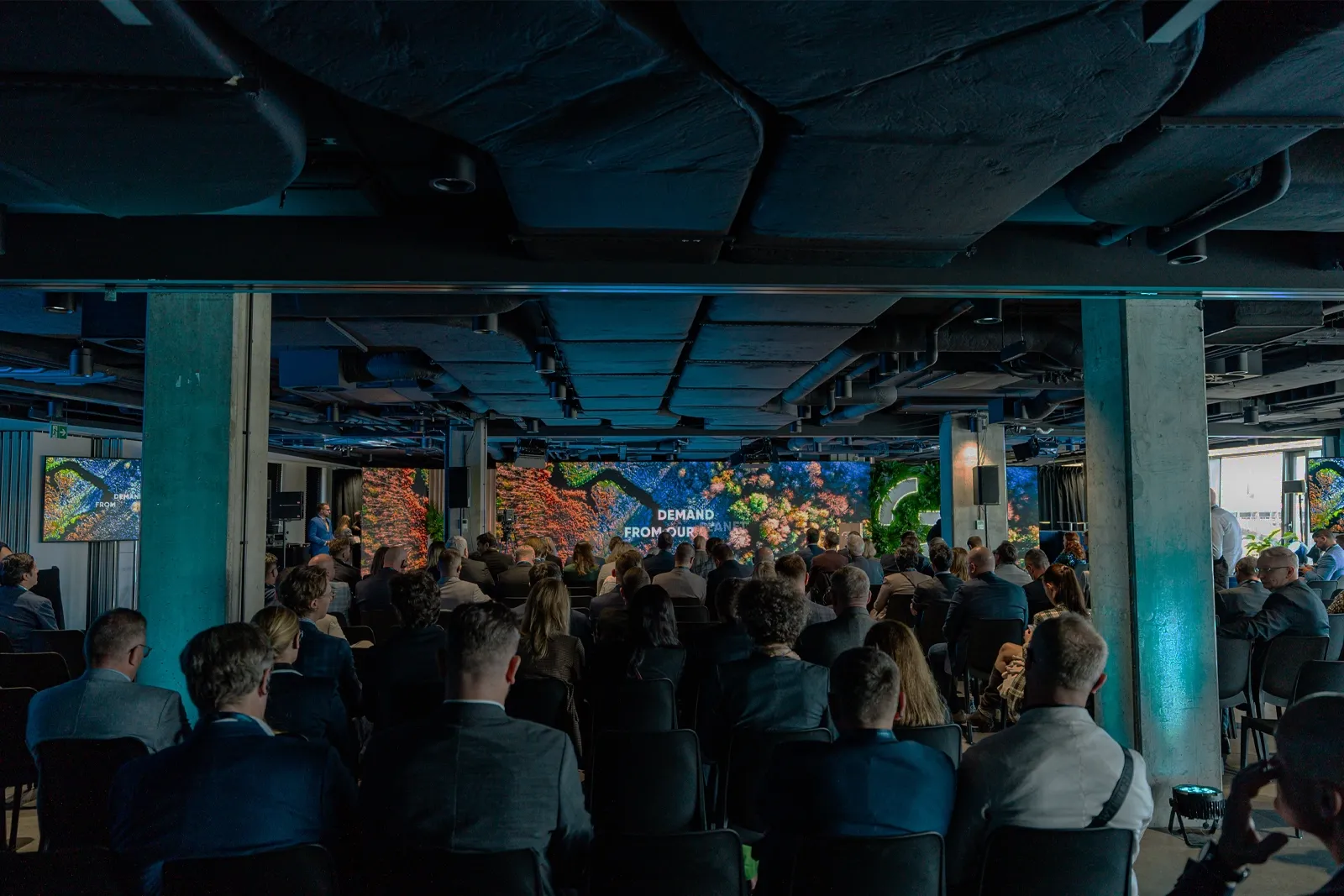
Decentralized energy took center stage at the second edition of BeNext – Europe’s Forum for Innovation in Decentralized Energy. This year’s edition, held in Warsaw and followed by the inaugural forum in Lisbon, focused on how distributed generation is reinforcing Europe’s energy security, competitiveness and independence. The event also addressed the necessary legislative changes to accelerate the development of this sector and emphasized the role of innovation and digitization – including energy storage, self-consumption, and energy sharing models.
Organized by Greenvolt Group, BeNext has established itself as a platform for decision-makers, investors, innovators, and companies to discuss specific solutions for the renewable energy sector and decentralized green technologies.
The Opening Session feature the Polish Ministry of Climate and Environment and the European Commission, underlining both national and EU perspectives on the role of Distributed Generation in shaping the energy landscape.
Representing the Polish Ministry of Climate and Environment, Anna Latuszek, underlined the crucial role of renewable energy sources in the country’s energy strategy. She also noted that the Polish government’s current priority is the rapid development of renewable energy sources while ensuring the continuity of energy supply and energy security – framing the energy transition as a civilizational challenge that must be addressed.
According to João Manso Neto, Poland is already a market with a certain level of maturity, but some decision-making processes need to speed up significantly.
”In the world we live in, renewable energy sources are a crucial element of the transformation, but we must think globally, about the entire energy system. With energy security in mind, we must create a system that is reliable, affordable, and provides adequate energy. Diversifying energy sources is key. Today, it is impossible to rely on just one source.
João Manso Neto, CEO of Greenvolt Group.
From a European perspective, Tom Howes, advisor on green transition and market regulation, DG Energy from European Commission shared the prospects for European Union directives regarding energy transition. “After Russia’s invasion of Ukraine, priorities had to change. We wanted to create conditions in which energy would be affordable. It turned out that we needed to do much more to free ourselves from volatile energy prices and dependence on the largest players”.
Throughout the discussions, leading experts shared practical insights on how decentralized solutions can support a sustainable transformation in both the EU and Poland. A key priority identified was the integration of solar PV with storage, coupled with the urgent need for more transparent regulation, stable legislative frameworks and the modernization of existing grids.
Speakers also stressed the importance of citizen engagement and energy literacy to accelerate adoption of renewable solutions. The growing role of aggregators in consolidating flexible demand was highlighted as another crucial step towards system efficiency. In parallel, panellists underlined how digitalization and artificial intelligence are reshaping the sector, enabling closer interaction with consumers, supporting their involvement in decision-making, and helping to reduce the overall costs of system transformation.
The debate further explored how to maintain the momentum of decarbonization by maximizing decentralized solutions and making better use of existing spaces for renewable deployment.
Decentralized Solutions for a Sustainable Transition in EU and Poland
The first discussion panel brought together Anna Latuszek (Polish Ministry of Climate and Environment), Walburga Hemetsberger (CEO, SolarPower Europe), João Manso Neto (CEO, Greenvolt Group), Piotr Listwoń (President of the Polish Power Exchange) and Henryk Kaliś (President of FOEEiG).
The debate addressed the current outlook for Europe’s renewable energy market, the key enablers and barriers to scaling distributed generation, and the role of policy frameworks such as the Affordable Energy Action Plan and the Clean Industrial Deal. Participants also reflected on Poland’s 2030 roadmap, the potential of distributed energy for energy-intensive industries, and the importance of unlocking industrial self-consumption through improved regulation and transparency.
“We need a system that supports solar energy and storage from a market perspective. Solar energy is the foundation, but it can be optimized and supplemented with storage. Therefore, we need to create good conditions for storage, but also to promote energy-sharing models that maximize the use of available space for renewable energy production and enable those who cannot install solar panels to participate in the transition. Energy storage and sharing are two key pillars that must be given absolute priority,” urged João Manso Neto.
Innovation and Digitalization Driving the DG Market
The second panel featured Michał Motylewski (Director of Energy Transition, Clyde & Co), Michael Villa (Executive Director, smartEn) and Aleksandra Radwańska (Vice President, Polish Chamber of Energy Storage and Electromobility).
Speakers explored the major trends reshaping the B2B energy market, including the integration of AI into grid flexibility and demand response, AI-driven building management systems, and the synergies between storage and renewable generation. The conversation also highlighted emerging business models such as energy-sharing platforms and the regulatory frameworks needed to unlock flexibility markets across Europe.
“AI is key to unlocking the potential of flexible material and resource management. We need stable legislation that doesn’t change every two years. We need to end the conflict between investors and legislators. Member states must define a clear roadmap for flexibility,” stressed Aleksandra Radwańska.
Key Drivers Shaping the Distributed Generation Market
Opening the afternoon, Tomasz Marciniak, Managing Partner at McKinsey Poland, outlined the main drivers and challenges for distributed generation in Europe and Poland. He highlighted the sector’s economic attractiveness, the push for energy independence and societal demand for sustainability, reinforced by regulation. At the same time, he noted the pressure of price normalization, regulatory volatility and financing hurdles in Central and Eastern Europe. Looking ahead, Marciniak projected steady annual DG growth across Europe, with Poland emerging as one of the most dynamic markets, entering a new phase of value creation through integrated and tailored solutions.
Business-Ready Solutions for Decentralized Energy
The afternoon session focused on practical applications of distributed generation, with contributions from Anna Szelc (Senior Director, Investments Poland, Invesco Real Estate), Peter Kennedy (Energy Manager, Tesco Ireland) and Jakub Safjański (Director of the Department of Energy and Climate Change, Lewiatan Confederation).
Discussions ranged from self-consumption and collective energy-sharing schemes to scalable storage for commercial and industrial applications, EV fleet charging strategies, and the role of smart infrastructure in driving efficiency. Case studies and business voices gave tangible insights into the decision-making processes and financial models that are bringing DG projects to life.