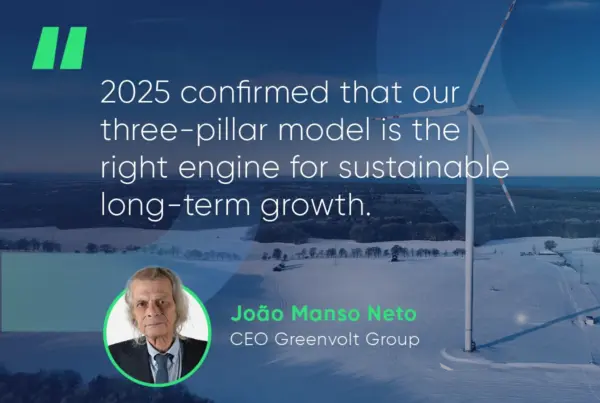
Welcome to the interview with João Manso Neto, CEO of Greenvolt Group
How do you reflect on 2024 for the Greenvolt Group?
Overall, 2024 was a year of strengthening and consolidation for the Greenvolt Group. We reinforced and expanded our position in key markets across all three business segments.
The year was clearly marked by a change in our shareholder structure, with KKR & Co. Inc. becoming our sole shareholder, completing a process initiated at the end of 2023. We are extremely confident that this milestone in the Group’s history further strengthens our financial and strategic capabilities, enabling us to scale operations and accelerate growth and innovation in the renewable energy sector.
It was also a year of evolution in our organization, during which we surpassed the milestone of 1,000 employees, with people from 45 nationalities, reflecting our culture of diversity, and with 35% of the workforce being women – a percentage clearly above the benchmark in our sector. The strengthening and cohesion of our team were further supported by the maturation of our organizational processes and tools, positioning us to enhance efficiency and continue delivering on our ambitions and objectives.
From a business perspective, in the Sustainable Biomass segment, we maintained a strong focus on improving the efficiency of our plants. In Portugal, we began constructing the new Mortágua II plant, a more modern and efficient facility that will play an important role in converting forest residues into valuable energy resources. In the United Kingdom, we agreed to acquire 100% of Kent Renewable Energy Limited, which operates a plant in Sandwich, southeast England. With this acquisition, Greenvolt’s sustainable biomass energy production capacity now totals 179.2 MW, including 68.7 MW in England, positioning us among the five largest producers of biomass-based electricity in the country.
In the Utility-Scale segment, we expanded our project pipeline and, in Poland, we reached a significant milestone by securing 1.2 GW of capacity for six battery energy storage system (BESS) projects, positioning us as a leading European player in this field and one of the largest developers globally.
In the Distributed Generation segment, we strengthened our pan-European platform for self-consumption solutions, entering new markets such as Romania and officially launching Greenvolt Next in Poland, a strategic market for the Group. Outside Europe, we entered Indonesia in partnership with Spectrum-R, making a concrete contribution to the energy transition of the industrial sector in the country.
In summary, 2024 was a pivotal year that reinforced Greenvolt’s ability to innovate, expand, and lead in the renewable energy sector. We are now better prepared to fulfill our business plan and achieve the Group’s strategic objectives.
Considering the macroeconomic scenario, what are your expectations for 2025 regarding the energy sector and, specifically, for Greenvolt Group?
2025 is expected to be a particularly challenging year, shaped by geopolitical tensions and modest economic growth, especially in the Eurozone. Conflicts in Europe, the Middle East, and Africa, along with rising protectionist tendencies in key markets, particularly in the US, will challenge economic performance and may lead to greater social instability, with political repercussions that increase uncertainty. Despite this, the energy transition remains a necessity. Climate change, energy security, and societal demands leave no alternative. Renewables have proven their economic and financial value, making them a logical choice for governments and businesses. We expect the shift to renewables to accelerate, driven by their undeniable role in securing a sustainable energy future.
In 2025, the Greenvolt Group will continue committed to delivering 100% renewable energy solutions, creating a direct and tangible positive impact on society and the planet.
The Sustainable Biomass segment will continue to be a pillar of our activity, which for us makes perfect sense, as it is a mature and reliable renewable technology that provides 24/7 baseload energy in an affordable way while generating significant positive externalities, such as forest cleaning, wildfire risk reduction, and the promotion of the circular economy.
The company will also expand its global Utility-Scale pipeline (Wind, Solar, and Storage), a key driver in accelerating the energy transition by producing large volumes of clean energy, with ambitious goals to develop projects at least up to the RtB stage. But we firmly believe in the importance of a diversified energy mix, integrating various sources and accommodating projects of different scales.
In line with that, Distributed Generation will remain central to Greenvolt’s strategy. Self-consumption solutions are both necessary and rational, enabling companies to leverage existing built spaces – such as rooftops, solar carports, and facades – maximizing asset value while reducing electricity bills through sustainable energy consumption. Even when energy production exceeds consumption, the surplus can be shared within energy communities, fostering collaboration and optimizing resources.
2025 will also be a year of focus and development in the storage sector, with preliminary work already underway on six large-scale BESS projects across Europe, totaling 558 MW. This includes the construction of the first two out of six projects awarded in the capacity market auction in Poland, two projects in Hungary, and the initiation of two projects in the UK. Additionally, this strategic focus on storage extends to the Distributed Generation segment, where we will continue integrating batteries with photovoltaic systems, enhancing efficiency and maximizing the potential of self-consumption units.
So, our strategy is clear: to continue executing our strategic plan, focusing on our business segments, fully aware that we are on the right side of the energy transition – the side of developing renewable solutions, which are and will increasingly be essential.
In light of what you’ve just shared, if you could make one wish for 2025, what would it be?
In a context where the urgency to accelerate the energy transition is undeniable, and where it is equally clear that this goal can only be achieved by significantly increasing renewable energy capacity, it is crucial that decision-makers – whether in politics, business, or other areas – focus on critical long-term priorities over short-term concerns, addressing what is truly important rather than simply reacting to what seems urgent in the moment.
Decisive and timely action, particularly in streamlining licensing processes, remains essential and, unfortunately, continues to be one of the main bottlenecks in the sector. Equally important is encouraging companies and entrepreneurs to take strategic decisions regarding their energy management, an approach that is crucial not only for environmental reasons but also for financial and competitive advantages.
This is especially true in the DG sector, which, according to European Commission forecasts, is expected to account for 25% of electricity consumption in Europe. DG has the potential to be a significant part of the solution from every perspective – environmental, social, and financial – and we see it as a segment that can and should be further developed, helping to democratize access to renewable electricity, create measurable sustainability benefits, and offer a cost-effective approach for both businesses and governments.